People who are living in a more developed country will tend to hold a higher standard. When good-looking fruits have become a trend at the market, the growers will grow as much as possible to secure the supply. Extra resources, such as soil, land, labor, machines, time, and the like will be invested to grow fruits. To compensate for the extra expenses as well as the loss of throwing away the ugly looking fruit, the farmers will somehow transfer a portion of the loss to the end users. Nonetheless, part of the loss is still covered by the farmers. Big farmers might have more resources to bear the cost, but it is not the same case for the small farmers. They have no choice but to fold their businesses.
This situation has existed for more than a decade now. Vanessa Wilhide, a grower from California, claims that currently, the produce industry is lacking young people to join because of the hard work and low economic returns. Long hours, expensive labor, high maintenance cost of machinery, unexpected weather, and pests are the major setbacks that drain away the passion and hope of a farmer. Not only does her son refuse to join the industry, but he also keeps urging her to quit. The fewer the growers, the lower the food supply will be. When the supply becomes scarce, it automatically drives up the cost and results in high prices at the supermarket. Unfortunately, this is only part of the story.
What’s more, food waste has become a pressing concern that worries most environmentalists and scientists.
Why is food waste such a huge concern then?
Apart from the fact that the price paid for the misuse of unnecessary resources is extremely high, the creation of methane from decomposing food in landfills causes serious environmental issues. Greenhouse gases will accelerate the process of climate change. All of that will exacerbate the entire ecosystem, followed by the collapse of biodiversity. When the food chain malfunctions, the quality and amount of food are adversely affected.
According to Statisca, around 30% of food is wasted or lost each year. Within that, produce contributes to over a 25% loss. This is a very alarming figure compared to other categories, such as meat.
According to the World Health Organization, around 733 million people faced hunger in 2023. On average, one in eleven people is facing catastrophic hunger, with 20% of hunger cases existing in Africa.
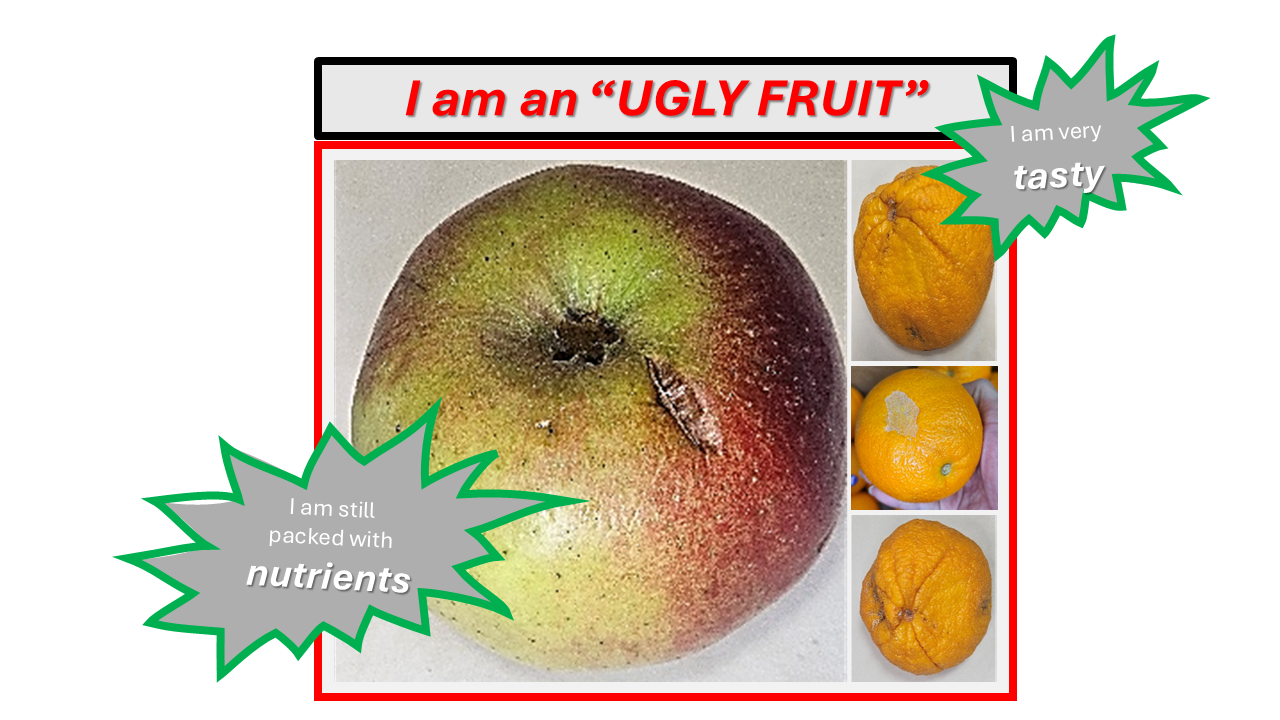
To make our world a better world, some European countries are taking the initiative to respond to it at a ground level. For example, in France, a trendy and forward-thinking country - and in order to arouse public awareness - an “Ugly Fruit” campaign was launched among some of the major supermarkets. Like the motto of the EU funded project: “Beautiful people buy ugly fruit.” In other words, people who buy ugly fruit are beautiful. Why, you may ask? Because those people are kind and open minded; they look beyond the appearance and care about the true value of a thing. These characteristics are considered as inner beauty which you can possess all your life.
Luckily, this campaign was a great success. It serves as a wake-up call to the public that inner value should be what we emphasize. It is like a gift; the wrapping paper does not change the nature of the gift inside.